Documentary spotlights efforts to return Amis lost souls
http://www.taiwantoday.tw/ct.asp?xItem=184821&ctNode=427
Taiwan Today 01/14/2012 By June Tsai
http://www.taiwantoday.tw/ct.asp?xItem=184821&ctNode=427
Taiwan Today 01/14/2012 By June Tsai
In a documentary film directed by anthropologist Hu Tai-li, young Amis of the Tafalong community strive to bring back ancestral spirits and reconstruct a family home that had special ceremonial importance. But since traditional ceremonies and ancestor worship have long been marginalized in the tribe, can those ancestral spirits really come home?
Thanks to efforts by tribal youth that commenced a decade ago, the spirits of the Tafalong ancestors, which had been taken to a museum along with the tribal artifacts that held them, were finally returned to their hometown after a five-decade absence. Their return has offered an opportunity for reviving tribal culture.
How did Tafalong’s ancestral spirits come to leave home in the first place? And how do the current Amis tribespeople of the village, who have long since converted to Christianity, view their relationship to the ancestral spirits?
Hu Tai-li, a research fellow at the Academia Sinica’s Institute of Ethnology, has made a documentary film about the process of recovering Tafalong’s ancestral spirits, called Returning Souls. A film tour with screenings at six prominent US universities, including UC Berkeley and Harvard, just ended in April. In November 2012 the film recieved a special mention for the Prix du Patrimoine Culturel Immateriel (Intangible Cultural Heritage Award) at the renowned Jean Rouch Film Festival for ethnographic and anthropological documentaries in Paris, and in April 2013 it won a Remi Award in the category “Film and Video Production—Ethnic/Cultural” at the WorldFest–Houston International Film and Video Festival in Houston, Texas.
Ten years ago, an email from Fuday, an elementary school teacher in Tafalong, created shockwaves at the Academia Sinica. The email delivered a request for the Institute of Ethnology to return some carved pillars that had been in the Kakita’an ancestral home in the Tafalong community of Amis. It was the first time that Aborigines in Taiwan had themselves initiated a request for the return of cultural artifacts from a museum or academic institute.
By then, most of the tribal community’s young people had moved to the cities for their educations or careers, leaving behind a debilitating sense of anxiety fostered by uncertainty and cultural loss. Amid that atmosphere, Fuday and other youths had organized a book club to encourage discussion and interviews with tribal elders. They came to the conclusion that they could only reinvigorate Tafalong’s spirit by rebuilding the Kakita’an ancestral home.
In August of 2003, Fuday and other tribal youths paid their first visit to the Institute of Ethnology to hold discussions on the matter. Hu Tai-li, who was also on the board of the institute’s museum, picked up a video camera when the Tafalong youth arrived. It was the beginning of a documentary process that would stretch on for eight years.
In negotiations with the institute, Fuday reaffirmed that the Kakita’an household held a status in Tafalong that was akin to a presidency over the community. It was, for instance, responsible for dictating how the tribal lands were divided. Other youths noted that when their ancestors would come back from headhunting, they would place the heads that they had taken in the Kakita’an home. The building hosted all of the ceremonies connected to headhunting, which were of paramount importance to the tribe.
Ethnological research has determined that the Kakita’an was the only Amis ancestral home with carved pillars. The Tafalong origin myths are depicted in the pillar carvings: a girl that emanates light, a great flood, a brother-sister marriage, a heavenly shaman’s descent to the world, and the hunting of a father’s head by his sons.
But the question remains: Why did these young Tafalong people go to the Institute of Ethnology to bring the Kakita’ans back home?
In 1958 a typhoon destroyed the Kakita’an home, which was a wooden structure with a thatched roof. Of the nine pillars that were inside, seven were salvaged and temporarily set aside. Academia Sinica research fellow Jen Shien-min, who had an interest in Aboriginal architectural carvings, asked his colleague Liu Pin-hsiung to go to Tafalong to collect them. It was thus that these seven pillars that depict Tafalong myths came into the possession of the Institute of Ethnology.
In 2003, during discussions between the Tafalong youth and the institute, Jiang Bin, who was then the institute’s assistant director, reminded Fuday and the other youths that “culture isn’t just a few pieces of wood.” Moreover, due to the condition of the wooden pillars at that time, they weren’t suited for reuse. Not long after those discussions, the tribal youths revisited the Academia Sinica, bringing with them a medium, who conjured forth the ancestral spirits.
That most senior of tribal shamans—or sikawasay—was Kating Hongay, a woman in her late 60s. Wearing the traditional black sikawasay clothes, she stood in front of the pillars and sprayed out a mouthful of rice wine. She leaned forward, her body constantly shaking, as she passed along the ancestral spirits’ complaints: “Where are the descendants of the Kakita’an? Why can we see none of them?”
Why indeed hadn’t the descendants of the Kakita’an come with the tribespeople to see the Tafalong ancestral spirits? Exploring this question, Returning Souls delves into conflicts between the Kakita’an family and the tribal powers that be, as well as the differences between Aboriginal traditions and modern laws. There was a dispute between the Kakita’an family and the tribal chief over who had rights to the land around the family’s ancestral home. The Kakita’an descendants were taking legal action to get land that had been confiscated by the Japanese, and later taken over by the community as a whole, to be returned to the Kakita’an family.
It turns out that from 1895 to 1945, the Japanese colonial administration prohibited the Kakita’an from hosting headhunting ceremonies, and forced the members of the family to leave their home, designating the building a historic monument and the land surrounding it national property. After the Japanese left, the tribe continued the arrangement set up by the colonial government, insisting that the land belonged to the tribe as a whole.
As a result of that land dispute, Kakita’an descendants were unwilling to go with the other tribespeople to the Institute of Ethnology to visit their ancestors’ spirits, arranging instead to visit by themselves at another time.
“My mother Saumah Geliu was a 58th-generation Kakita’an,” says the 59th-generation Tipus Saumah to the camera.
As these successive groups of Amis tribespeople came to the Academia Sinica to discuss the return of the pillars, Hu Tai-li, who was filming their visits, began to wonder: Assuming that the pillars should go back to Tafalong, to whom should they be given? “I, at least, feel that Tipus has the strongest claim. After all, it was her relatives that carved these pillars and built the structure.”
When the young tribespeople returned to the village and discussed how to continue to press forward, they took a new tack based on what the medium Kating had said: “We realized that we didn’t want the pillars; we wanted the spirits of the old people that were inside the pillars.”
On August 14 of the following year, on a scorching summer day, the Tafalong youth, accompanied by the Tafalong chief, tribal representatives, and a mountain boar, came once again to the Institute of Ethnology, bringing offerings of pork to feed the ancestral spirits. The medium conducted a ceremony as they prepared to bring the spirits back to the tribe, while leaving the seven carved pillars depicting traditional myths in the museum. The dispute over these cultural artifacts had come to a conclusion.
When the ancestral spirits returned to the tribal village, they were first placed in a thatched hut where the Kakita’an home used to stand. In 2005, with assistance provided by the institute to purchase building materials and pay for carving expenses, work began on rebuilding the Kakita’an ancestral home.
Yet, with the land dispute within the tribe unsettled, the process of rebuilding the Kakita’an home was a rocky one.
On the legal front, the township office had sent people out to the site to plant signs declaring: “No construction allowed.” The threat was loud and clear. Fearing that the Kakita’an home would be razed after reconstruction was completed in January of 2006, Tipus took the advice of the Institute of Ethnology to send an application to the Hualien County Cultural Bureau to have the building protected as a cultural site, averting the danger that it would be torn down.
Issues of face played a role. The tribal leaders, including the chief and elected representatives, didn’t support reconstructing the ancestral home of the Kakita’an, whose economic and social status in the community had fallen.
It turns out that the Kakita’an, in addition to controlling tribal lands, had also been a provider of social welfare to the community. The Kakita’an family took on responsibility for helping the poorest members of the tribe—widows, orphans and so forth.
Tipus, who left for Taipei to work as a hairdresser when she was 16, admits that her mother hadn’t previously actively pushed to rebuild the Kakita’an home, largely because the family was so poor. Even if she had insisted upon trying to rebuild, the lack of money would have left the job unfinished, and that, she explains, would have been humiliating for their ancestors.
Even now, most people in Tafalong use the Amis word kitaan (place of wealth) to describe the Kakita’an home, ignoring the ceremonial functions served within. A young tribe member named Tilo analyses it thus: Although many of the tribal elders had no strong feelings either way about whether the home should be rebuilt, they didn’t object because its reconstruction would permit the holding of ceremonies and the observance of taboos unique to the Kakita’an that couldn’t be duplicated elsewhere in the community.
Take the Ilisin, the annual ceremony of the greatest importance to the tribe. Traditionally, the first day of the ceremony would be spent at the Kakita’an home, with offerings of food given to the ancestral spirits. With the decline in the Kakita’an family fortunes, the ceremony was simply not observed for 50 years. No one in the community had tried to usurp their authority over such ceremonial matters.
Perhaps it’s of greater relevance to point out that like most other Aboriginal peoples in Taiwan, the Tafalong have largely converted to Christianity, placing their faith in God and shunning ancestral spirits. Today visitors to Tafalong find three beautiful churches: Catholic, Presbyterian and Seventh Day Adventist. The Catholic congregation is largest.
“Would the Tafalong ancestral spirits, which had been away for nearly 50 years, be able to adapt to the changes in the tribal village?” Hu Tai-li asks this sensitive question about clashing faiths in her documentary Returning Souls.
Even Tipus’s mother, a 58th-generation descendant of Kakita’an, converted to Catholicism after the Japanese left. “We were so poor back then there was no other way,” recalls Tipus. “To get baby formula and clothes, many converted to Catholicism.”
Yet, it can’t be denied that although the land dispute has not been settled, the Tafalong’s ancestral spirits have already returned, and their return has gradually changed life in the community. The teachers and students of Tafalong’s elementary school use the Kakita’an ancestral home for experiential education. They sit in a semicircle inside and sing traditional Amis songs and learn about the Amis origin myth. “Rebuilding was hard work,” says Tipus. “But knowing that the ancestral spirits have a comfortable home like before gives me peace of mind. It makes me happy.”
Although the Kakita’an family can no longer play the key role in the tribe’s most important annual ceremonies as it did a half century before, Tipus remains undeterred: Since rebuilding, she’s been holding her own ceremony outside the ancestral home every year. The tribal youths are optimistic, believing that so long as the ceremony continues to exist, the Kakita’an and the tribal spirit will live on. They believe that at some point in the future the tribe as a whole will once again recognize the importance of the Kakita’an.
“When seeing the rebuilt Kakita’an home, two kinds of people cry,” writes Fuday, reflecting on the decade-long movement to welcome the ancestral spirits back to the village. “One type cries because they see it as it used to be. The other type cries because they see the difficulties looming on the path ahead.”
Returning Souls is a poignant film that shows how traditional Aboriginal culture has repeatedly been bent and twisted over the course of history. The film bears witness to the courage of people persevering in the face of insurmountable odds.

《讓靈魂回家》胡台麗回到部落 祭告祖靈
自由時報 記者花孟璟/花蓮報導 2012年2月25日
 |
《讓靈魂回家》紀錄片中,Kakitaan祖祠7根祖靈木柱中描述「獵首起源」的Mayao Kakalawan雕像。(記者花孟璟翻攝) |
中研院民族學研究所研究員兼紀錄片導演胡台麗,耗時八年完成《讓靈魂回家》紀錄片,描述花蓮太巴塱Kakitaan祖祠、祖靈柱歷經頹圮、重建的曲折故事。昨天導演胡台麗將帶著片子回到部落,除了早上舉辦祭祀,告訴祖靈「拍片完成」,晚間也舉辦播映會,希望邀請族人共同回憶這段幾乎被遺忘的故事。
〔祖祠及祖靈柱 已列國寶〕
花蓮光復鄉太巴塱部落的Kakitaan祖祠內的七根木柱,在族人眼中,是祖靈的居所,更是記敘了部落的古老傳說,文建會去年也提列為中華民國「國寶」。Kakitaan家族的祭師何財源,指著其中一根刻有Mayao Kakalawan的形像的柱子,講述太巴塱部落「獵首」文化的起因,其實來自一則「子弒父」因而「成年」的傳說。
何財源說,Mayao和父母、弟弟住在一起,有天兄弟倆奉父命取水,卻發現溪水混濁,父親得知後說,「如果發現污染水源的人,就一刀砍下他的頭」,兩兄弟隔日再取水,果真發現「兇手」並迅速獵頭,一看才發現砍死的是父親,最後Mayao以死和父親和解,變成清晨天空的星星。
胡台麗說,Kakitaan祖祠木柱的圖案,記述了遠古的大洪水、會發光的女孩、兄妹成婚、巫師降世,以及獵首起源自弒父等傳說,早在一九三五年,台北帝國大學教授移川子之藏從事調查時,這棟祖祠及木柱就被指定為史蹟。
〔祖祠重建過程 完整記錄〕
一九五八年,祖祠被颱風吹垮,柱子也被中研院學者搬回民族所收藏,至二○○三年,部落一群年輕人和祭師去了中研院,透過祭師,族人發現祖靈柱裡的祖先靈魂還在,「祂們」呼喊著想要回家的願望;最後族人如願迎回祖先的靈魂,並且重建了祖祠,紀錄片當中也完整紀錄了整個過程。
胡台麗說,在拍攝當中,可以看到部落年輕人面對外來宗教信仰,以及祖祠的土地所有權、複雜的部落派系生態裡,想要喚起部落重視古老祖靈信仰時所遭遇的困難,以及他們對夢想的堅持,非常動人。
《讓靈魂回家》紀錄片回到部落,除了上午舉辦祭祀以稟告祖靈,晚上七點在太巴塱國小活動中心放映,還有精彩的會後討論。
( http://www.libertytimes.com.tw/2012/new/feb/25/today-north16.htm )
( http://www.ksnews.com.tw/newsdetail.php?n_id=0000218995&level2_id=105 )
「你們終於來了!」中研院昨天舉行阿美族太巴塱祖屋重建紀錄片《讓靈魂回家》首映,寄身於民族研究所博物館的花蓮太巴塱部落祖靈再度現身,表達想回家的心願,出現「家族大團圓」意外插曲。
八年前,祖靈透過巫師Kating向中研院討回祖屋木柱的Kakita’an家族代表芙代,說出等待近五十年的心願,希望迎靈返回部落,重建被颱風摧毀的祖屋。
Kakita’an家族後代與祖靈「失散」半世紀,透過巫師溝通「重逢」的感人故事,經民族所研究員胡台麗八年拍攝成紀錄片《讓靈魂回家》。昨日首映會上,Kakita’an家族盛裝出席,每個人看完眼眶溼潤,直說:「感動到快噴淚!」
首映會還出現一段插曲,巫師Kating到達民族所博物館時又被附身,兩個祖靈透過巫師向族人抱怨,他們上次沒有跟著回家,在中研院多住五年,這次一定要跟大家回家。
芙代說,重建祖屋的過程,讓他深深感觸「老人家」對文化傳承的重要性,若非祖靈啟發,大家也不會想到透過複製重建祖屋,恢復原有的祭儀文化。
胡台麗指出,Kakita’an祖屋是阿美族唯一有雕繪圖紋的木柱建築,雕繪家族故事包括大洪水、巫師降世及獵敵首起源等神奇傳說,為阿美族最有名、也最受外界矚目的建築。太巴塱部落敵首祭等重要祭儀,都在祖屋外舉行,由Kakita’an家族擔任祭司。
日治時期Kakita’an祖屋被指定為史蹟保存,但胡台麗說,日本殖民政府別有居心,透過指定史蹟,消滅原住民獵首祭儀及文化。Kakita’an祖屋一九五八年被溫妮颱風吹垮,家族受到日本殖民打壓,沒有經費重建。
直至民族所研究員劉斌雄到花蓮田野調查時,在花蓮縣議員萬仁光協助下,把傾倒在廢屋中的六根雕紋木柱搬回中研院保存。附身在雕紋木柱的Kakita’an祖靈,也跟著「搬到」中研院。二○○八年芙代尋線找上門,透過巫師溝通,與族人「重逢」,並表達希望重建祖屋,傳承太巴塱部落祭儀文化的願望。
胡台麗表示,當年太巴塱年輕人找到民族所,「我就知道他們想要回祖屋木柱,重振太巴塱精神,讓我非常感動。」這部紀錄片,不只是家族重建祖屋的紀錄,也是文化省思。
自由時報 :http://www.libertytimes.com.tw/2011/new/dec/11/today-life4.htm
太巴塱祖靈的一句呼喚/胡台麗記錄神奇祖屋 讓靈魂回家
 |
【記者湯佳玲/台北報導 2011.12.11】「你們怎麼現在才來!」祖靈的一句呼喚,促成中研院民族所研究員胡台麗花了八年時間拍攝最新民族誌紀錄片「讓靈魂回家」,記錄阿美族最神奇的一棟祖屋裂解與重建的故事。
台灣阿美族在文獻上最有名的一棟建築為太巴塱Kakita’an家的祖屋。祖屋柱子上有許多圖紋,講述太陽母神後裔包括大洪水、會發光女孩、兄妹婚、巫師降世,以及弒父與獵首起源等神奇傳說。後來颱風將祖屋吹倒,七根柱子在一九五八年搬移到中研院民族所博物館收藏,今年十一月被文建會認定為第一批「國寶級」原住民文物。
二○○三年起,太巴塱年輕人、Kakita’an家族和村落代表與巫師一同來到中研院民族所。太巴塱國小教師芙代.谷木.母那烈回憶,透過巫師媒介,Kakita’an家族和柱子中的祖靈對話,當時祖靈說的第一句話就是:「你們怎麼現在才來!」讓他們了解到祖靈想要回到家鄉花蓮太巴塱部落的心願,終於在二○○四年將祖屋柱中的祖靈請回部落,二○○六年完成祖屋的重建。
隨著外來宗教影響、土地所有權爭議與複雜的部落文化生態,阿美族年輕人想找回太巴塱祖靈和部落靈魂的文化復振夢想遭遇許多困難。紀錄片導演中研院民族所研究員胡台麗,前後追蹤了八年,拍攝完成「讓靈魂回家」,記述這段漫長而動人的歷程。胡台麗說,以前拍攝紀錄片是用十六釐米膠卷,這次是用DV拍攝,原本以為會快速許多,沒想到反而拍了兩百多輯,剪輯上十分困難。她希望重建的祖屋能夠刺激部落文化追本溯源,讓部落更有自主性和靈性活力,也希望「讓靈魂回家」能夠帶動更多有心從事文化復振的部落與社區的討論、思索與行動。
聯合報 :http://udn.com/NEWS/READING/REA8/6774073.shtml
太巴塱 迎祖靈回家
感知祖靈 →重建祖屋→迎靈安置→胡台麗跟拍 紀錄8年漫長路
Kakita'an家祖屋是阿美族文獻上最有名的一棟建築,祖屋柱子上有許多圖紋,代表該部落的發光女孩、兄妹婚、弒父與獵首等許多傳說。一九五八年溫妮颱風將祖屋吹倒後,民族所研究員劉斌雄透過花蓮縣前縣議員萬仁光(兩人皆已故)協助,徵得部落同意後,將這些柱子運到民族所博物館收藏。
後來,太巴塱部落人由通靈者感知到柱子中的祖靈,祖靈想回家;他們找上民族所,不是要那些柱子,而是要迎回祖靈。胡台麗表示,留在民族所的七根柱子上月已經文建會認定為第一批國寶級原住民文物。
何玉蘭表示,還有兩位祖靈、她「阿祖」的兄弟當初沒有跟著回去,希望他們一定要跟著回部落。胡台麗說,這些祖靈離開部落五十年,她一直很想知道祖靈們能適應部落的變遷嗎?
太巴塱東北社區發展協會理事長林恆智指出,文史工作就像和文化賽跑,Kakita'an祖屋的文化價值是我們看不到的。」芙代.谷木.母那烈說,他相信所有文化可能都有句點,只是現在還不知道在哪裡;然而,會留下的文化,祖靈就會讓它留下。
公共電視:
http://www.youtube.com/watch?v=oeUdMz-Q3o0&feature=youtu.be
鳳凰網: http://phoenet.tw/Newsletter/Comment.aspx?Iinfo=5&iNumber=3284
"讓靈魂回家" 胡台麗讓太巴塱祖屋祖靈再度現身
〔鳳凰網記者麻念台 台北特稿 2011.12.10〕
 |
| 搬移到中央研究院民族學研究所博物館收藏的雕紋木柱。(歸鴻亭攝影) |
也是資深紀錄片導演的胡台麗指出,Kakita'an祖屋是阿美族唯一有雕繪圖紋的木柱建築,柱子上雕繪家族故事圖紋代表著該部落的大洪水、會發光女孩、兄妹婚、弒父與獵首、巫師降世及獵敵首起源等等許多傳說,是阿美族最有名、也最受外界矚目的建築。
 |
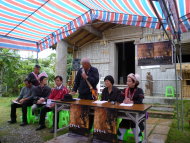
| 中央研究院民族學研究所研究員胡台麗(右)說明拍攝紀錄片《讓靈魂回家》的歷程,左方為太巴塱部落巫師和Kakita'an家繼承人。(歸鴻亭攝影) |
太巴塱部落人由通靈者感知到柱子中的祖靈想回家,8年前他們來到民族所,希望要那些柱子,並迎回祖靈。
今日親自穿著阿美族盛裝出席的太巴塱巫師曾金蘭以母語說明,他們要請祖靈的儀式地點不是在太巴塱部落而是在中研院,是因為中研院民族所博物館裡頭三根柱子,因為祖靈一直在柱子上。
太巴塱國小教師芙代.谷木.母那烈回憶,當年透過巫師媒介,Kakita'an家族和柱子中的祖靈對話,當時祖靈說的第一句話就是「你們怎麼現在才來」,由於祖靈想要回到家鄉花蓮太巴塱部落的心願,在2004年將祖屋柱中的祖靈請回部落。
 |
| 在中央研究院民族學研究所迴廊的另外3根雕繪圖紋的木柱,傳說阿美族祖靈就住在這裡。(歸鴻亭攝影) |